

In a festival season that is brimming with dazzling shows, The Dan Daw Show arrives with a quieter kind of audacity.
In a festival season that is brimming with dazzling shows, ‘The Dan Daw Show’ arrives with a quieter, and subversive kind of audacity.
“I was turned on by a disabled person… that’s interesting.” So says Dan Daw.
The Australian disabled dancer has already run ‘The Dan Daw Show’ across the world, where it has been widely acclaimed and nominated for multiple dance awards. It comes to the Royal Lyceum Theatre as an Edinburgh International Festival debut from Saturday 2 – Monday 4 August.
Exploring kink, a subject which both liberates and challenges, the show explores dominance, submission, interdependence, care and softness — not as abstract concepts, but as lived realities, shaped by the politics of the body.
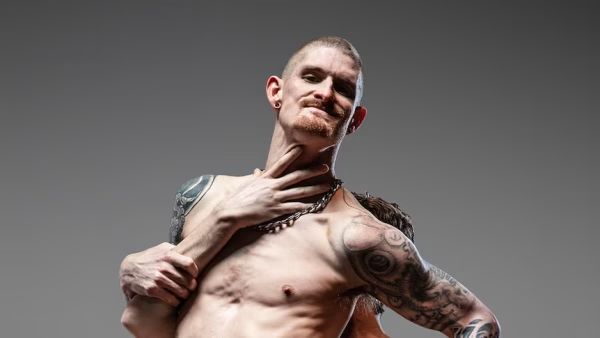
The push-pull nature of this is a metaphor for how the world sees disabled bodies. With sexy choreography and touching theatricality, The Dan Daw Show takes a stand against ableism.
At the heart of the show is Daw himself: a queer, disabled artist whose proud presence on stage alone is a declaration.
His whole life, he has been told that he’s ‘brave’ or ‘an inspiration’ for living in an ableist world, but that is flawed “if it’s because they don’t have anything else to say or they don’t know how to speak to disabled person”.
The Dan Daw Show is a very daring invitation to understand the way in which he sees the world, and how the world sees him.
Naomi O’Toole spoke to Dan Daw for the Quinntessential Review to find out more ahead of its EIF opening.
——-
The Dan Daw Show will soon make its debut at the Edinburgh International Festival. But you’ve performed The Dan Daw Show across the world. Starting at Dance City in Newcastle in 2021, you’ve taken this show across the UK, to Germany, Australia, Greece, Belgium, Portugal and many more. Have you seen audiences receive the show differently?
“It’s similar in that we’ve had a lot of incredible responses from the queer community, the disabled community, the kink community – but a big surprise is feedback from women, reminding them to take up more space in the world.”
Your work really interests me in the way you connect power and sexuality. A key theme is reclaiming power, but in a way that is subversive, perhaps in a way some people would initially think is relinquishing power. In that way, you’re redefining what having power means, and what having power looks like. Why did you choose the world of kink and sexuality to tap into this?
“My thinking around the show began with inspiration porn; the idea that a disabled person is inspiring for simply getting out of bed in the morning.”
Dan explains further, that if he took the lift, he’s seen as a burden, but as a disabled person, if he took the stairs, he’s often referred to as an inspiration.
“I became fascinated by the pornographic nature of that and how it’s quite perverse.”
Did you want to make work about inspiring others?
“I wanted to make work about inspiring myself and what brings me the most power and joy. I feel the most power and joy when I’m performing and when I’m fucking.
That’s why the sub-dom relationship takes form.”
Christopher Owen (Dan’s collaborator, who appears in the show) as the dom essentially is an allegory for the world: “showing the audience how I want to be with the world (how I am with my dom) and how I want my dom (aka the world) to be with me.”
Dan, how would you define kink?
“To me, it’s sex that isn’t focused on making babies. It’s sex for the pleasure of it and finding different ways to make your partner feel good.”
We are promised some sexy choreography, and your list of Trigger Warnings on your website mentions ‘sexy Disabled People’. “Dan Daw is a sexy disabled person. The Dan Daw Creative Projects team includes other sexy disabled people.” What do you think is the best way to show sensuality or sexiness on stage? How can you give the audience some butterflies?
“To me, it’s sex that isn’t focused on making babies. It’s sex for the pleasure of it and finding different ways to make your partner feel good.”
Dan Daw defines ‘Kink’
“I think it’s by keeping it real. Although the show had been going for four years, we respond in the moment to how we are with eachother. The intimacy, connection and sensuality is very present and very real.”
Dan described a moment in the show where he drinks water that spurts from Chris’ mouth. As the water trickles down his body, Dan licks it off. Moments like these definitely heighten sensuality. It is an action that is very visually striking, while also being tactile. But Dan maintains, though there is a set of things him and Chris do in the show, the heart of sensuality is “not being scared to be with each other.”
You are a disability advocate through your work. When you first wrote this show, how did you approach framing disability or explaining it to non-disabled audiences?


The Dan Daw Show © Shannyn-Higgins for Rising 30
“I didn’t worry too much about explaining it to non-disabled audiences as there’s real pride and joy in not having to explain it. To let my body do its thing and let the audience watch.
Then going away and processing it and thinking, oh well I was turned on by a disabled person… that’s interesting.
In my work, I look at myself and when I look at myself it prompts audiences to look at themselves, it makes them look at themselves and their relationship to intimacy. And it creates a sense of collective togetherness.”
You talk about inspiration, and a habit that people have of calling you ‘an inspiration’. Do you want to be an inspiration to others?
“There’s no harm in being an inspiration to others, it’s just about what people do with it.
If I inspire someone to go and do something or make a change, then I think that’s great!
If it’s because they don’t have anything else to say or they don’t know how to speak to disabled person, then it’s not.
But if I inspire someone, there’s no harm in that because inspiration keeps us going, right?”
“There’s no harm in being an inspiration to others, it’s just about what people do with it.“
Dan Daw
What do you find inspiring?
“In these times, which are essentially the apocalypse, I am inspired by people who are still able to be kind, gentle and soft. I really admire those qualities in people, who – no matter what happens – are still able to be kind, gentle and soft.”
We spoke more about softness, since softness and sensuality go hand-in-hand. Softness is also key when presenting something vulnerable to an audience.
Dan elaborated, “softness came from lockdown. When I was writing the show, I noticed how much my body started to soften as I wasn’t going out every day. I wasn’t having to navigate difficult situations everyday.
I call this being in my soft shell – it’s a kind of acceptance if someone is giving ablesim.
Softness is very important, especially as a man. I grew up in a very alpa male dominated environment in outback Australia, so I really try to counteract that as much as I can.”
Radical self-acceptance is something we talk about in wider society now. It’s something I am still learning too. And as an artist, self-acceptance becomes tangled up with feelings like imposter syndrome, particularly if you are tapping into a very vulnerable part of yourself. At what point in your life or career did you find this?
“I’m still finding self acceptance, and funnily enough, our next work is about imposter syndrome and interrogating the value I place on myself. That’s the next show. If The Dan Daw Show was about accepting my body, the next show is about valuing my body, in a world where others don’t.”
Another concept I think is interesting at the moment is the semiotic relationship between the artist and the art. As you make the artwork and shape it, it also shapes you. As you’ve developed this show, have you found anything to change within yourself?
“Yes, absolutely. When I made this show, it was so important to me that it was kink looking at kink, because it was something I felt shame about. I didn’t have the wherewithal or confidence to say ‘yeah, I’m kinky’ and celebrate myself within that.
But when I found myself doing it and having a deep conversation in the room about doing it, it wasn’t as scary as I thought. It was very liberating to use the work as a vehicle to get closer to the person I’ve always wanted to be.”
One final thing is about something I noticed in your email signature. ‘Dan Daw Creative celebrates crip time. This means we may not be able to get back to you immediately and the culture of immediacy is something we want to challenge through our rest and disability justice practices. As we set our work hours by our capacity, which can fluctuate, you may hear from us at odd hours. We do not expect a reply outside your working hours.’
You mention resisting the culture of immediacy, and rest. There is definitely a hustle culture, and dancers in particular face burnout and injury. Then, there are also terms like ‘productive rest’, which still retain rest within the means of its output. What do you think needs to be done to normalise genuine rest?
“We are all inventing this urgency and immediacy, but it’s a creation of our own doing. We just need to collectively say no, we aren’t going to do that.”
It’s a lot to do with what we are fed. Dan refers to meal deals and takeaway coffees, which convince us we’re really busy.
Instead, we should be “resisting that and saying no, we can only work on these days. We take four days off in Easter every year and the world doesn’t burn.
I wrote something today actually; ‘I’m aware that my body isn’t able to conform, and therefore I resist.’ There’s no point in burning myself out.
People need to re-learn how to wait. If you grew up in the 80s, you knew how to wait. If you planned to meet your friend, you had to stick to the time, because you couldn’t change it last minute. It meant more responsibility and integrity.” Dan jokes, “I’m sounding like a man now!“
“But because we are able to change things so quickly, we don’t stick to things. We have this little thing in our pocket that rings whenever someone needs us, so we can never be off. We are always switched on. I think we’d be better if we went to the days of answering machines, and culturally saying ‘no’.”
Anything else?
“I’m really excited for this show at EIF.”
Dan draws on his personal experience to create this show. But – as he mentions with the culture without rest, reckoning with our own intimacy and how women in the audience take a message to take up more space in the world – there is an undercurrent which connects to us all personally.


 By
By