

“I mean, God, we’re coming to Edinburgh, which is the greatest place in the world.”
Bob Barrett is looking ahead to a fiercely guarded week off. There is a quick jaunt to Paris with his daughters for his wife’s birthday, a funeral to attend, and then he is straight back on the road. The destination, however, is one he has been eagerly anticipating.
Barrett is currently traversing the country as MI5 operative Colonel Race in the mammoth Fiery Angel production of Agatha Christie’s Death on the Nile. Ken Ludwig adapted the text, and Lucy Bailey directs; it is a colossal, sliding-set beast of a show that brings the sun-drenched, blood-soaked luxury of the SS Karnak to regional stages. Before we get into why the upcoming run at the Festival Theatre constitutes a deeply personal homecoming for the actor, we need to talk about the murders.
Sun, Spies, and Underestimating Poirot
Barrett knows exactly how to navigate a high-society body count. He toured with the same creative team on Murder on the Orient Express and And Then There Were None, but Death on the Nile offers a distinct shift in temperature.
“There’s an expanse to it which there wasn’t in the train,” Barrett notes. “The train was—my God, we were cramped in that. And I love that… stuck on this train, there’s no disco, what’s going to happen? That made it more dramatic in a way. What makes Nile different is that this play is about love. It’s about three people, a love triangle, and they’re young. I really love how we can do two different plays which have a similar shape, but apart from that, I love the difference.”
On the Karnak, Barrett plays Colonel Race, Hercule Poirot’s sounding board and resident espionage expert. To prepare, he bypassed the grey-suited operative trope entirely.
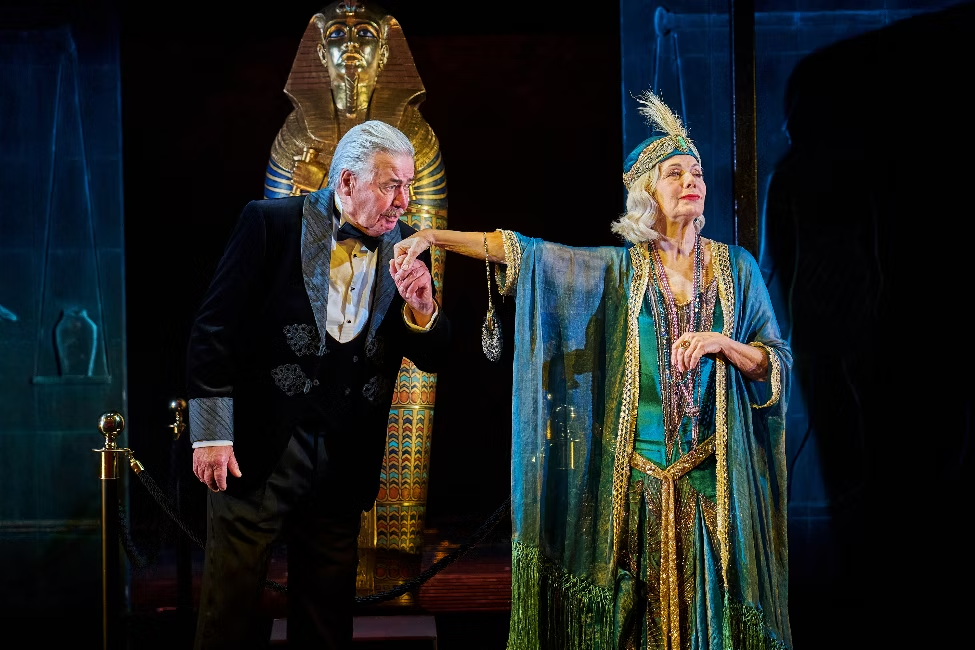

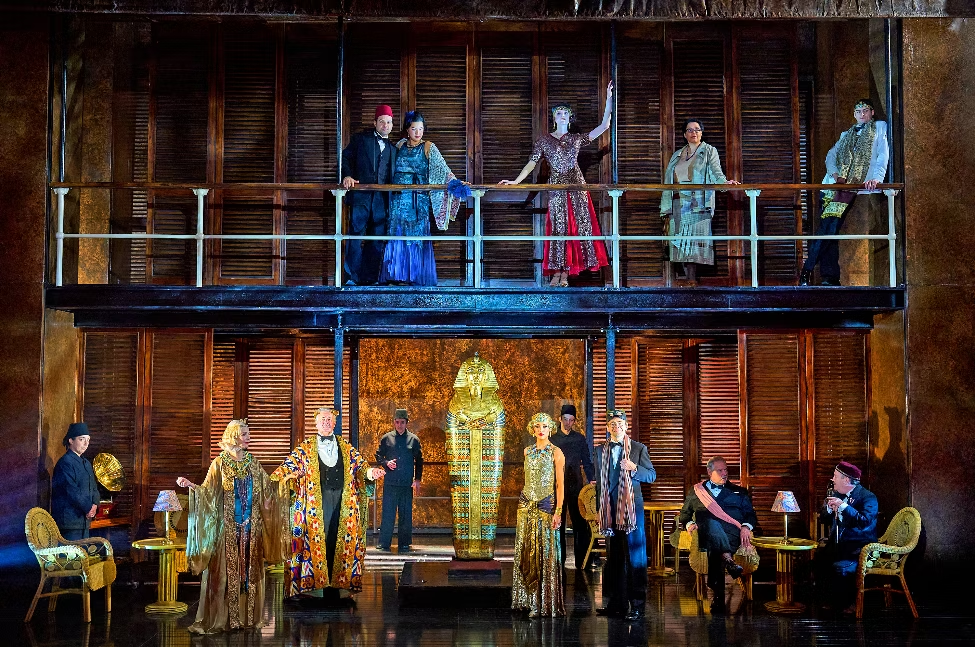
“I was always obsessed when I was young, and still am, with spies—particularly the Cambridge spies like Guy Burgess,” he explains. “There are two types of spies. There’s the one you never know is in the room; they just sit and watch. Or there’s the Burgess spy, who is the very last person on earth you’d suspect. I went down that route. He’s quite funny. You wouldn’t expect him to be a spy, and then it comes out at the end that he is. I think people love the pride he has when he finally says, ‘I’m from MI5.'”
“I mean, God, we’re coming to Edinburgh, which is the greatest place in the world.”
Playing Race also means stepping into shoes previously filled by cinematic titans. “My personal favourite was James Fox,” he admits. “I loved the way he had a twinkle in his eye when he played it. I think that’s another thing about Race—he just appears, tells these stories about the adventures he’s had, and then he’s off to do something else. I love that.”
He acknowledges the David Niven legacy too—”brilliant in it… but he’s more laid back”—yet he clearly relishes the freedom his supporting role affords compared to the heavy expectations placed on Mark Hadfield’s Poirot.
“You are coming at the end of a vast group of actors, so you’ve got to find something new,” Barrett notes of the iconic detective. He laughs, recalling the historical pedantry surrounding the role. “I know Peter Ustinov got such grief when he was playing it from people saying he was too tall. There’s this height restriction—Poirot has to be small. And I’m tall, but that’s part of the dynamic between us.”
Such dynamic is where the real thrill of the play lies, particularly in how the doomed passengers treat their resident genius.
“Never underestimate anybody,” Barrett warns. “People are against Poirot, partly because they have a huge thing to hide and they’re scared of him, because he’s bright. There’s a real antagonism towards him. I love those scenes where people think they’re cleverer than Poirot. They’re great scenes because you feel Poirot loving the fact that he’s being underestimated. He thinks, ‘Great, I love that you’re underestimating me, because I can find out more, and I can dig deeper.'”
Dining With the Detective
When I ask if the touring company dinners ever mirror the iconic Christie denouements—with the cast instinctively turning to Hadfield’s Poirot for a grand revelation over dessert—Barrett laughs.
“No, not really,” he says. “You kind of expect people to be like their characters, and often they never are. Mark is quieter. He’s funny, he’s great, but it’s a different thing. You embrace the different people in the room.”


He notes that Hadfield brings an entirely distinct energy compared to Michael Maloney, who played the Belgian detective on the Orient Express tour. “He’s a totally different Poirot to Michael’s. It shows there’s so much space for these things to work. When we all meet around the table, a lot of the energy comes from the young ones in the company, fresh out of drama school. They’re so charismatic and great.”
A Theatrical Homecoming
While Race is a man constantly dropping in and out of adventures, when Barrett was a fresh-faced young actor, his own compass pointed firmly towards a very specific stage. When the production docks at the Festival Theatre, it will not be just another tour date. His association with the Scottish capital was forged in the rehearsal rooms of the city’s rep scene over three decades ago.
“I got together with my wife in 1993,” Barrett explains. “The first job we did after that was in Edinburgh at the Lyceum with Kenny Ireland. We did The Recruiting Officer and A Midsummer Night’s Dream. Then, off and on for the next ten years, I came back and forth to work with Kenny. In the end, I did about eight shows with him. It became a huge part of our lives.”
He pauses to take stock of his geographical footprint across the city. “I’ve done the King’s, and this is my third time at the Festival Theatre. I’ve never actually done the Traverse—I used to go to the bar all the time because I had so many mates in there working—but pretty much every other theatre in Edinburgh I’ve played, which is amazing.”
Modern touring frequently reduces cities to hotel rooms and rapid get-outs. Barrett remembers an entirely different rhythm. “When my daughter was born, we brought her up to Edinburgh; Kenny looked after her while we were working, so the city is really in our DNA. It feels like home. It’s different when you tour and you’re only there for a week. When you’re there for months, you truly get to know a place. I know all the nooks and crannies, and I miss it when I’m not there.”
Stop Being Grateful, Start Expecting
That foundational grounding in Scottish regional theatre informs Barrett’s sharp perspective on the modern circuit. We discuss the frustrating dichotomy where audiences outside of London are conditioned to feel lucky when a major production drops by.
He seizes on the sentiment immediately. “You’re right. That standard should be everywhere. Just expect it. Start expecting it, and stop being grateful.”
He recalls a revealing conversation from his Lyceum days. “I remember Kenny going to a meeting, and I asked who was going to be there. He said the people who run the Traverse, the Opera House, and the cinemas. I asked why, and he said, ‘Because we all have to work out how to balance. If you’re doing a very big, successful show that will get bums on seats, you have to be careful about everyone else.’ When I asked why again, he told me, ‘Because we have the same population as Ipswich.'”
Despite those demographic challenges, Barrett is a fierce advocate for pushing large-scale work out of the metropolis. “A lot of theatre is very Southern-centric. Touring is vital because you want to get as much theatre to every part of this country as possible.”
He shares a story from a previous Christie tour stop at the Theatre Royal in Newcastle, shortly after the post-COVID reopening. “The people who ran the theatre were almost in tears. They said that after COVID, audiences had come back for musicals, but they weren’t coming back to plays. That was the first time they’d seen a play sell out. People just love Agatha Christie, and I was very touched by that. We live and die by people coming to the theatre.”
Nodding and Winking at Murder
Serving that massive, hungry audience across the UK means navigating the fierce loyalty of the Christie purists. Tinkering with her legendary roster comes with serious risks.
To ensure the lore remains intact, the production works closely with the author’s estate. “James Prichard, Christie’s great-grandson, runs the estate and he’s a wonderful lad. He’s incredibly loyal to his great-grandmother, so everything has to go by him. He will step in and say, ‘No, we can’t have that,’ because he remains very respectful of the original work.”
Within those strict boundaries, however, Ken Ludwig’s script finds plenty of room for meta-theatrical playfulness.
“I was always obsessed when I was young, and still am, with spies—particularly the Cambridge spies like Guy Burgess,” he explains. “There are two types of spies. There’s the one you never know is in the room; they just sit and watch. Or there’s the Burgess spy, who is the very last person on earth you’d suspect. I went down that route…”
“It’s funnier than the other two I’ve done,” Barrett points out. “Ken’s a comedy writer, so there’s a lot more self-awareness. There’s a nod and a wink to the accepted tropes you get in all her books. When I first come onto the boat, I say, ‘I’m glad you’re happy because we don’t want any murders this time.’ The audience loves it. Then I point out to Poirot that wherever he goes, there’s a murder, and everyone laughs because that’s exactly what they came for.”
To My Dying Breath in the Ensemble
At the core of Barrett’s enthusiasm is a fierce devotion to company acting. He learned his trade within a dedicated Scottish ensemble, and he recognises how rare that structure has become.
“I believe, to my dying breath, in the ensemble,” he states firmly. “I think that creates the best theatre. Everyone is equal. No matter what part you play, everyone joins together and makes it work for each other.”
It is a system he fears is slipping away for the next generation, a reality he sees firsthand. “Both my daughters are actors, and it’s infinitely harder for them now because we had rep,” he notes. “I came to Edinburgh and got to learn my trade at the feet of amazing people. That’s not really as available now, and I think we’re in danger of allowing that culture to just crumble.”
So it comes as no surprise that Barrett is thrilled to be part of a large touring company that functions as a family, bringing a sturdy, sharply designed piece of suspense to audiences across the country. As the Death on the Nile company prepares to embark on its Scottish run, his focus is entirely on the voyage ahead.
“Every single show I will love, particularly being in Edinburgh. It’s gonna be an incredible week and I just can’t wait.”
Featured Image: Bob Barrett in rehearsals for Death on the Nile – photo by Manuel Harlan
Details
Show: Death on the Nile
Venue: Festival Theatre, Edinburgh
Dates: Tue 24 – Sat 28 Mar 2026
Running Time: 2 hours 20 minutes – including interview
Age Guidance: Family Friendly
Admission: From £23.50
Time: 14:30, 19:30
Accessibility: Fully Accessible Venue


 By
By

 By
By


![Review: [Un]lovable – Not So Nice! Theatre Company – Traverse Theatre](https://i0.wp.com/theqr.co.uk/wp-content/uploads/2026/03/Russ-Russells-Clown-Divorce.jpg?resize=600%2C570&ssl=1)


